

Editor’s Note: This post was updated on March 23, 2026, for accuracy and comprehensiveness. It was originally published on April 27, 2016
Walking 10,000 steps a day is often promoted as a simple way to burn calories and lose weight. But how many calories does 10,000 steps burn in reality?
The short answer: it depends. Your body weight, walking speed, and overall activity level all play a role, and the number can vary more than most people realize.
In this article, we’ll break down how many calories 10,000 steps burn, explain why the results aren’t the same for everyone, and show how walking fits into a realistic weight‑loss plan backed by science.
Key Takeaways
For most people, walking 10,000 steps burns around 300 to 500 calories, depending on how much you weigh and how fast you walk.
Walking alone won’t lead to fat loss unless you're also in a calorie deficit, meaning you burn more calories than you eat.
That said, walking has major health benefits: it improves heart health, boosts mood, supports mobility, and helps build a healthy lifestyle.
Is 10,000 Steps a Day Really the Magic Number?

You’ve probably heard that walking 10,000 steps a day can burn around 3,500 calories in a week, which is often linked to losing one pound of fat. It’s a popular idea among some fitness sources, and it comes from a long-standing rule of thumb in nutrition that’s still widely referenced today.
That rule is based on the idea that one pound of body weight equals about 3,500 calories. From there, the math seems straightforward: burn or cut around 500 extra calories a day for seven days, and you’d theoretically reach that 3,500-calorie mark.
At first, it seems pretty simple.
The problem is that this calculation only works in certain situations. It depends on things like your body, your pace, and what you’re eating. For many people, hitting 10,000 steps alone does not lead to weight loss.
Let’s take a closer look at why.
How Many Calories Are Burned in 10,000 Steps?
The number of calories you burn from walking 10,000 steps depends on a few things, including your body weight, how fast you walk, and your stride length. In other words, it looks different for everyone.
That said, we can use a general example to see how the math usually works.
Here’s a common estimate:
10,000 steps is roughly equal to 5 miles
A 180-pound person burns about 100 calories per mile
That adds up to about 500 calories for 10,000 steps
Over a week, that’s 500 calories a day times 7 days, or 3,500 calories
But this example only works if you weigh around 180 pounds.
If you weigh less, your body uses less energy to move the same distance. For example, a 120-pound person burns closer to 60 calories per mile. That means:
60 calories per mile times 5 miles equals about 300 calories a day
Over a week, that’s 2,100 calories burned
That’s about 1,400 calories short of the 3,500 calories often linked to losing one pound of fat.
Bottom line: How many calories does 10,000 steps burn depends on how much you weigh, pace, and effort. The heavier you are and the faster you walk, the more calories you tend to burn. If you weigh less, walking the same number of steps will burn fewer calories, even if the distance stays the same.
Here’s a general estimate to help you put things into perspective:
Body Weight | Estimated Calories Burned from Walking 10.000 Steps |
120 lbs (54 kg) | ~300–340 calories |
150 lbs (68 kg) | ~350–400 calories |
180 lbs (82 kg) | ~420–480 calories |
210 lbs (95 kg) | ~480–550 calories |

Body composition, explained.
Understand what fat mass, skeletal muscle mass, and body water reveal that BMI can't.

How Speed Affects Calories Burned from 10,000 Steps
On average, 10,000 steps equals about 5 miles. But it really depends on how fast you walk. Walking speed plays a big role in calorie burn, even when the distance stays the same.
Let’s look at examples of different types of bodies walking for 30 minutes and approximately how many calories they burn depending on their speed:
Speed (level ground) | 120 lb | 150 lb | 180 lb | 210 lb |
2–2.4 mph (easy) | 80 calories | 100 calories | 120 calories | 140 calories |
2.5 mph (casual) | 86 calories | 107 calories | 129 calories | 150 calories |
2.8–3.4 mph (moderate) | 109 calories | 136 calories | 163 calories | 190 calories |
3.5–3.9 mph (brisk) | 137 calories | 171 calories | 206 calories | 240 calories |
4.0–4.4 mph (very brisk) | 157 calories | 196 calories | 236 calories | 275 calories |
4.5–4.9 mph (very, very brisk) | 200 calories | 250 calories | 300 calories | 350 calories |
5.0–5.5 mph (power walk) | 243 calories | 304 calories | 364 calories | 425 calories |
As you pick up the pace, your heart rate goes up, and your body uses more energy, even if you’re walking the same distance.
One important thing to keep in mind: Many claims about “10,000 steps leading to one pound of weight loss per week” assume a brisk walking pace. If you walk more slowly or don’t cover the full distance, you will burn fewer calories.
And one last reminder: Hitting your step goal alone does not guarantee weight loss. Walking helps support fat loss, but it only works when your overall calorie intake stays in check.
Why Walking Alone Won’t Lead to Weight Loss If You Overeat

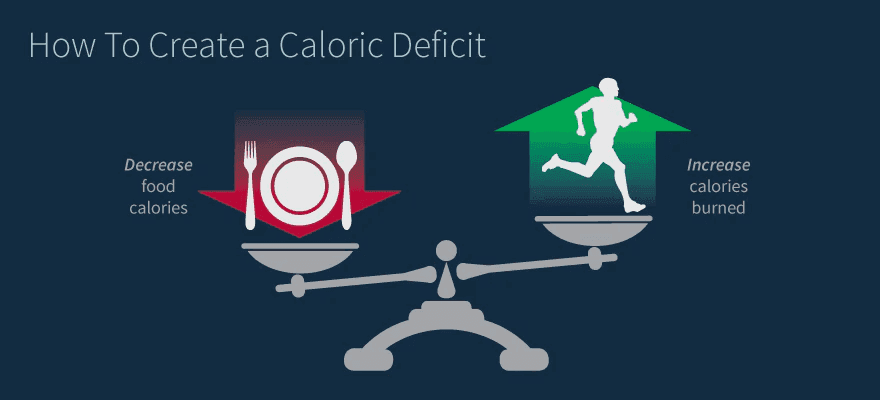
Walking helps you burn more calories. But if you are still eating more than your body needs, fat loss will not happen. This is where calorie balance matters.
To lose weight, your body needs to burn more calories than it takes in. This is called a calorie deficit.
Let’s look at a real-life example to see how this plays out.
Example 1: No Fat Loss from Caloric Balance
Let’s look at a 180-pound person who:
Burns about 1,800 calories per day at rest
Walks 10,000 steps and burns an extra 500 calories
That brings their total daily calorie burn to 2,300 calories.
Now, if that same person eats 2,300 calories in a day:
2,300 calories in − 2,300 calories out = zero.
That’s calorie balance.
Result: No fat loss and no weight gain. The body simply maintains its current weight.
Example 2: Fat Loss with a Calorie Deficit
Now let’s look at the same 180-pound person, but with one key change.
They still walk 10,000 steps and burn about 500 calories, but this time they eat 1,800 calories for the day.
Total calories burned: 2,300
Calories eaten: 1,800
2,300 burned − 1,800 eaten = a 500 calorie deficit
Result: This person is in a calorie deficit, which is the starting point for fat loss. If they keep this pattern for seven days, they would burn about 3,500 calories, which is roughly equal to one pound of fat.
Want to Know If This Would Work for You?
That depends on your own metabolism, especially two key numbers: your Basal Metabolic Rate (BMR) and your Total Daily Energy Expenditure (TDEE).
Here’s a simple way to estimate them and use BMR to lose weight:
Start with a body composition test, which can measure things like body fat percentage and lean mass. Some result sheets include your BMR directly.
Multiply your BMR by 1.2 to estimate how many calories you need to maintain your weight without extra exercise.
Once you understand your BMR and TDEE, you can set calorie and activity goals that actually fit your body, rather than relying on a one-size-fits-all step count.
What Matters More Than Hitting 10,000 Steps
When it comes to burning calories, improving health, or losing fat, the way you walk often matters more than the number on your tracker.
That’s why two people can both hit 10,000 steps in a day and still see very different results.
Walking Pace and Intensity
A slow, relaxed walk burns fewer calories than a brisk walk that gets your heart pumping. Even if your step count stays the same, walking at a faster pace increases the amount of energy your body uses.
Heart Rate and Effort
Calorie burn is closely linked to effort. Walking that raises your heart rate into a moderate-intensity range provides greater cardiovascular benefits and burns more calories than low-effort movement.
Time and Distance Matter
Ten thousand short, easy steps spread throughout the day is not the same as walking about five miles at a steady pace. Longer, continuous walks tend to have a bigger impact on both calorie burn and overall fitness.
Muscle Mass and Body Composition
Step count alone does not account for body composition. People with more lean muscle typically burn more calories, both at rest and during activity. This means two people who weigh the same can burn very different amounts of calories, depending on their muscle-to-fat ratio.
Walking Works, Even If Weight Loss Is Not the Result
Even if walking does not lead to weight loss on its own, it is still one of the best things you can do for your overall health.
Research consistently shows that regular walking supports heart health, helps lower blood pressure, reduces the risk of chronic conditions, and may even help you live longer. Adults who walk around 7,000 steps per day have a much lower risk of cardiovascular disease and early death compared to those who are less active.
Another recent study found that walking in continuous sessions of 10 to 15 minutes can be especially beneficial. Compared to scattered movement throughout the day, longer walking sessions were linked to a lower risk of heart attack, stroke, and other cardiovascular events.
Walking also makes it easier to meet the recommended 150 minutes of moderate-intensity aerobic activity per week, as advised by the American Heart Association. Because it is low-impact and easy to adjust to your fitness level, walking works well as a warm-up, a stress reliever, or a full workout on its own.
Ready to see where you really stand?
InBody is closer than you think — locations are in gyms, clinics, and studios nationwide.